


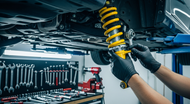
Lowering your car changes everything. The stance improves. The handling tightens up. The gap between the fender and the tire finally looks intentional instead of accidentally tall. Done right, it's one of the best modifications you can make to any enthusiast platform.
But there's one mistake that kills more suspension builds than anything else: people focus entirely on how low they want to go and completely ignore what happens to the geometry when they get there. You end up with a car that's slammed, looks great in photos, chews through tires every 10,000 miles, and pulls left at every freeway on-ramp. That's not a build — that's an expensive problem.
This guide walks through how to lower your car correctly — from choosing your method to getting the geometry dialed in so it actually drives better and not just looks better.
Three Ways to Lower Your Car
Before you buy anything, you need to pick your method. There are three real options:
1. Lowering Springs
Lowering springs swap directly onto your existing strut assemblies. They're shorter and stiffer than your factory springs, which drops the car and reduces body roll. The drop is fixed — you pick the spring rate and drop, install them, and that's where you sit.
Best for: Mild drops (0.75"–1.5"), budget-conscious builds, daily drivers where ride comfort is still a priority.
Cost: $150–$350 for quality springs. Add $150–$250 for labor if you're not doing it yourself.
Drawback: No ride height adjustment, and your stock dampers may not work optimally with the shorter spring travel.
2. Coilovers
Coilovers replace the entire spring and damper assembly with one adjustable unit. You can dial in your exact ride height, adjust preload independently, and tune damping on most performance setups. It's the most flexible option and the most popular for builds that need to do more than just look good at a fixed height.
Best for: Performance builds, stance builds, track use, anyone who wants to adjust their setup.
Cost: Entry-level starts around $400; quality units run $600–$1,200+.
Drawback: More expensive than springs, more complex installation.
3. Air Suspension
Air suspension replaces your springs with airbags, allowing you to raise and lower the car on the fly — sometimes while driving. The appeal is obvious: slam it for the show, raise it for the driveway, cruise at a comfortable height for the daily. The cost is significantly higher (typically $2,000–$5,000+ installed), and there's more to maintain long-term.
Best for: Show cars, cars that need maximum drop, builds where instant adjustability is the priority.
Cost: $1,500–$5,000+ depending on the kit and whether you're doing a manual or electronic system.
Drawback: Expensive, complex, and there's more that can go wrong compared to coilovers or springs.
How Low Should You Go?
This question gets answered emotionally more often than it should. The honest answer is that 1–2 inches of drop is the sweet spot for almost every daily-driven performance build.
The 1–2 Inch Sweet Spot
A 1-inch drop on most platforms closes the wheel gap, stiffens up the handling feel noticeably, and keeps the car livable on real roads. A 1.5-inch drop gets you into legitimate stance territory while maintaining reasonable geometry correction with a basic alignment. A 2-inch drop is aggressive — doable on the right setup, but you need to be ready to address camber, potentially run a camber kit, and accept some compromise in ride quality.
Beyond 2 inches, you're in specialized territory. The suspension geometry is working against you, you may need extensive correction parts, and rough roads become a serious issue. That doesn't mean it's wrong — show builds and dedicated stance cars often run more — but understand what you're signing up for.
Platform-Specific Considerations
Not every car responds to the same drop the same way. The GR86/BRZ sits low from the factory, so 1 inch feels more dramatic on that platform than on a stock-height Civic. The WRX has stiffer factory suspension, so a spring swap feels firmer than you might expect. Research your specific platform before you commit to a drop amount.
Clearance Check
Before finalizing your drop target, look at:
-
Subframe and crossmember clearance — especially at full droop and compression
-
Exhaust routing — aftermarket exhausts can sit lower and contact the ground on drops over 1.5"
-
Driveway angle at your house — the one clearance problem that bites people most often
-
Wheel/tire combo — a wider wheel with aggressive offset will have different clearance at full lock
Coilover Installation Overview
If you're going the coilover route and thinking about a DIY install, here's what the process looks like — not a step-by-step manual, but a real sense of what you're getting into.
What You'll Need
-
Floor jack and jackstands (minimum 2 stands; 4 is better)
-
Spring compressor (required for lowering springs; not always needed for coilovers)
-
Basic hand tools: 12mm–19mm sockets, ratchet, breaker bar
-
Torque wrench
-
Penetrating lubricant (for rusty hardware, which you will almost certainly have)
-
About 4–6 hours the first time
The Basic Process
-
Lift the car and support it properly — never work under a car on a jack alone
-
Remove the wheel — gives you access to the strut assembly
-
Disconnect the brake line bracket and ABS sensor wire — these route along the strut
-
Remove the bottom strut bolt(s) — where the strut connects to the knuckle/spindle
-
Remove the top hat nuts in the engine bay — 3–4 nuts hold the strut top to the chassis
-
Pull the old strut assembly out — the whole unit comes out through the wheel well
-
Install the coilover — thread in the upper mount, bolt in the lower mount, torque to spec
-
Route brake line and ABS sensor wire back — clip them to the new coilover body if needed
-
Reinstall wheel, torque lug nuts
-
Repeat all four corners
Pre-Alignment Ride Height Setting
Before you drive to the alignment shop, set your ride height. This is where coilovers shine — you can adjust the lower perch, drop the car off the stands, measure fender-to-ground or center-of-wheel-to-fender, and adjust until it's where you want it. Get it close before alignment. If you change ride height significantly after alignment, you'll need another alignment.
The Alignment Non-Negotiable
If you skip the alignment after a suspension change, you're doing it wrong. Full stop.
When you lower a car, the suspension geometry changes. The front and rear toe can shift. Camber changes. The steering angle reference points are different. Stock alignment specs are set for stock ride height. When you change ride height, those specs no longer apply.
What to Expect at Alignment
A good alignment shop will:
-
Measure your current angles (camber, caster, toe) before touching anything
-
Adjust toe and caster within spec
-
Flag any angles they can't correct with current hardware (this is where camber kits come up)
Budget $80–$150 for a full four-wheel alignment. Don't let them just do a two-wheel (front-only) on a lowered AWD car. All four corners matter.
How Often You Need to Realign
After initial install: immediately. After any significant ride height adjustment: again. Annually if you're daily driving it hard: worth it. After any significant impact (pothole, curb strike): yes.
Do You Need a Camber Kit?
When you lower a car, the front wheels often develop negative camber — the tops of the tires tilt inward relative to the car. A small amount is actually beneficial for cornering. Too much, and you're running on the inner edge of your tires all the time, which means accelerated wear and money out of your pocket.
Whether you need a camber kit depends on how much you've lowered and your platform's geometry. The general rule:
-
Under 1" drop: Probably fine with a standard alignment. Monitor tire wear.
-
1"–1.5" drop: Get an alignment and measure. Some platforms need correction, some don't.
-
1.5"–2"+ drop: A camber kit is almost certainly worth it to bring your angles back into spec.
TruHart Camber Kits are available for most popular platforms and let your alignment shop dial in proper camber angles that a standard alignment can't reach. If your shop tells you "I can't get the camber in spec," that's your signal — get the camber kit.
Common Beginner Mistakes
These are the things that most first-time suspension builds get wrong:
1. Skipping the Alignment
Already covered. Don't do it. The alignment is as important as the suspension itself.
2. Going Too Low Too Fast
A 3-inch drop might look incredible in render form and brutal in practice. Start at 1–1.5 inches. You can always go lower later. You can't un-destroy your CV axles or exhaust from being slammed with the wrong setup.
3. Buying Cheap Coilovers
The $200 coilover kit from an unknown brand is a false economy. You'll spend more on fixing what it breaks than the kit cost. If coilovers are in your budget, buy the cheapest quality unit, not the cheapest unit. There's a difference.
4. Not Checking Clearance on All Four Corners
People check the front and forget the rear. Or check static ride height and forget to check articulation (full compression). Test your clearance by pushing down on each corner of the car after lowering — simulate compression and make sure nothing is contacting.
5. Ignoring the Struts
If your stock struts have 80,000 miles on them and you add lowering springs, don't be surprised when the ride feels terrible. Springs on worn struts are a bad combination.
6. Not Torquing to Spec
Suspension components under-torqued will move. Over-torqued will strip. Get a torque wrench and use it. Especially on the lower strut bolt and top mount nuts.
First Mod Order of Operations
If you're new to this and building a car from stock, here's the sequence that makes the most sense:
1. Tires first (if stock tires are worn) You'll need new tires after alignment anyway. If you're close to replacement, do it before the suspension work so you're evaluating the new setup on a known baseline.
2. Suspension (springs or coilovers) The foundation of everything. Do this before wheels/tires so you know what ride height you're working with.
3. Alignment immediately after Right after install, before you put serious mileage on the new setup.
4. Wheels (if changing) Now that you know your ride height and offset requirements, pick wheels that work with your stance.
5. Camber correction if needed After alignment, if the shop can't hit spec, add the camber kit and re-align.
6. End links and sway bars (optional) Once the basic suspension geometry is sorted, these are the next performance upgrade — reducing body roll and improving cornering balance.
Getting the order wrong costs money. Buying wheels before you know your ride height means they might not clear. Skipping alignment means uneven tire wear before your new wheels even look their best.
Lower It Right
Lowering your car is one of the most impactful modifications you can make — but only if you respect the geometry work that has to come with it. Pick your method, set a realistic drop target, get the alignment done correctly, and address camber if your setup needs it.
Every great suspension build starts with the same foundation: the right hardware, installed properly, with the geometry to back it up.
Get Started with TruHart Suspension
TruHart builds suspension for enthusiasts who want real performance on the street — not just looks.
? Shop TruHart StreetPlus Coilovers — 30-way damping, independent ride height/preload adjustment, camber plates included. Available for Honda Civic, Subaru WRX, GR86/BRZ, and more.
? Shop TruHart Lowering Springs — Precision-engineered drop with street-tuned spring rates. Bolt-on upgrade for stock struts.
Find your platform and build it right.