


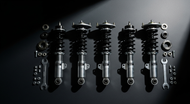
Not everyone has $1,500 for Ohlins. Or $1,200 for KW. And that's fine — you don't need to spend Porsche money to get a genuinely good coilover setup for your Honda, Subaru, or Toyota.
But the budget coilover market is full of landmines. There's a massive difference between a $250 no-name set from a drop-shipping storefront and a $650 purpose-built coilover from a brand that actually tests their hardware. Both are "budget coilovers." Only one of them belongs under your car.
This guide breaks down what to look for, how the price tiers stack up, and which specific options are worth your money at different budget levels.
What to Look for in Budget Coilovers
Before we get to specific products, here's what separates a decent budget coilover from the kind you'll be replacing in 18 months:
Monotube vs. Twin-Tube Construction
Most budget coilovers use a twin-tube design. The shock body has two concentric tubes — an inner tube where the piston moves and an outer reservoir for fluid overflow. Twin-tube is not inherently bad. Most factory shocks are twin-tube. But cheap twin-tube coilovers often use low-quality seals, thin shock bodies, and inadequate fluid that fades under heat.
Monotube construction puts the piston in a single larger-diameter tube with a floating divider separating oil from pressurized gas. It handles heat better, offers more consistent damping, and is harder to manufacture — which is why it typically shows up on more expensive units. If you find a budget coilover claiming monotube at $300, look harder at the construction before trusting it.
The key question isn't which design — it's whether the construction quality behind that design is adequate. A well-made twin-tube at $650 will outlast and outperform a claimed-monotube at $200 every time.
Spring Rate Appropriateness
Coilover spring rates matter. A spring that's too soft won't hold the car at ride height consistently and will wallow through corners. Too stiff, and the car is undriveable on anything but a smooth track.
For a daily-driven street car, front spring rates around 6–8 kg/mm and rear rates around 5–7 kg/mm are typical starting points for a spirited street setup. Dedicated track builds run higher — 10–14 kg/mm is not unusual front and rear for time attack applications. What you don't want is a budget coilover that specs "8kg front/6kg rear" on paper but uses actual spring wire that measures softer, because the manufacturer cut corners on the spring material.
Ride Height Adjustment Range
A coilover that only adjusts 0.5 inches in either direction isn't very useful. Look for at least 1–2 inches of adjustment range above and below what you'd actually run. This lets you:
-
Start at a conservative drop and go lower if you want
-
Raise the car for winter without going back to stock
-
Make small adjustments without hitting the limits of the system
Independent Ride Height and Preload Adjustment
On budget coilovers with a single adjustment collar, changing ride height also changes spring preload — the amount the spring is compressed at rest. This isn't ideal. When you lower the spring perch (dropping the car), you reduce preload. When you raise it, you increase preload.
Quality coilovers separate these two adjustments — a lower perch for ride height and a locking collar above to set preload independently. This lets you dial in the handling feel separately from the stance. It's a feature worth looking for even in the budget range.
Damping Adjustment
Single-direction damping adjustment (usually compression or rebound via a dial on the top or bottom of the shock body) is common in the $500–$800 range. It lets you soften the coilover for a comfortable daily commute or firm it up for a track day or canyon run.
Multi-directional (separate compression and rebound adjustment) is typically reserved for more expensive setups, but the ability to adjust one direction well is a meaningful feature even in budget territory.
Upper Mount and Camber Plate Quality
The upper mount takes a lot of abuse. It's the connection between your shock and the chassis, and it flexes, pivots, and takes impact forces constantly. Cheap upper mounts use pillow-ball bearings that notch and wear quickly, or rubber bushings that deflect and affect steering response.
Quality upper mounts use precision bearings or high-durometer bushings that maintain consistent geometry while allowing the required motion. Camber plates — upper mounts that let you adjust camber angle — add significant value, especially for lowered applications where factory camber range isn't enough.
The Price Tiers Explained
Under $400: Proceed with Caution
There are coilovers available under $400 — sometimes well under. Some brands in this range have decent build quality on specific platforms. Most do not.
What you typically get under $400:
-
Basic twin-tube construction with minimal quality control
-
Fixed or very limited damping adjustment
-
Mediocre upper mounts with limited life
-
Inconsistent spring rates between units (left and right may feel different)
-
Short or nonexistent warranty
If you're in this range, you're better off with quality lowering springs on stock struts. You'll get a more predictable result for less money and less frustration. The sub-$400 coilover market occasionally produces usable products for specific platforms — do significant platform-specific research before buying.
When under $400 makes sense: Your car is a cheap daily you're not building seriously, you just want to lower it a bit and you'll live with average ride quality. Even then, springs may be a better answer.
$400–$700: The Sweet Spot
This is where the real competition happens. The $400–$700 range includes some genuinely excellent coilovers — not just "budget" by resignation, but purpose-built performance suspension that competes with more expensive options in specific areas.
What you typically get in this range:
-
Proper damping adjustment (15–30 way)
-
Quality upper mounts with camber adjustment on many units
-
Independent ride height and preload on better designs
-
Adequate spring rates for street and light track use
-
1–2 year warranty from reputable brands
-
Good platform-specific fitment and engineering
TruHart StreetPlus coilovers live in this tier — specifically in the $600–$700 range — and represent what the category looks like when it's done right. More on those in the next section.
Other legitimate options in this range exist for specific platforms, but the quality floor is higher here than under $400 and the value-to-performance ratio is at its best.
$700–$900: Upper Budget
At this tier, you're getting into products that blur the line between "budget" and "enthusiast" coilovers. You'll find:
-
More sophisticated damping technology
-
Wider adjustment ranges
-
Better warranty support
-
Track-capable specs on some models
-
Higher-quality seals and fluid
The improvement over the $600–$700 tier is real but incremental for street applications. Where the premium starts to matter more is if you're tracking the car regularly, where consistent damping performance under heat becomes a real differentiator.
Top Picks at Each Tier
Under $400: Best Bet
If you're committed to spending under $400, Megan Racing Street Series coilovers are the most consistent recommendation for platforms they fit. Build quality is adequate and they're an improvement over many alternatives in this range. They're not exciting, but they're functional.
Honest caveat: At this price, expect to replace them sooner. The ride isn't going to make you forget KW exists. But they'll lower your car and adjust, which is the baseline requirement.
$400–$700: TruHart StreetPlus (Top Pick)
The TruHart StreetPlus is the recommendation in this range for Honda, Subaru, and Toyota platforms. At $600–$700 depending on application, they include:
-
30-way damping adjustment
-
Independent ride height and preload adjustment
-
Camber plates standard (front)
-
Quality twin-tube construction with proper fluid and seals
-
Good spring rates tuned for street and light track use
-
Solid warranty support
This is the set that competes with coilovers $300+ more expensive and holds its own in real-world testing. More detail in the next section.
Alternatives at $400–$700: BC Racing BR Series coilovers are competitive in this range for platforms TruHart doesn't cover. They have a wide catalog and reasonable build quality, though the camber plate situation varies by application.
$700–$900: Tein Street Basis Z / BC Racing ER Series
At the upper edge of budget territory, Tein Street Basis Z coilovers are a solid choice for platforms they cover. Tein has been making suspension for decades and their Street Basis Z balances comfort, adjustability, and performance well.
BC Racing's ER Series steps up from the BR with improved damping characteristics and is worth considering if you're pushing toward the track more than the street.
TruHart StreetPlus Deep Dive
The StreetPlus is TruHart's flagship street coilover, and it's the product that earns its place as the top recommendation in the sub-$700 range. Here's what makes it worth the money:
Camber Plates Included
Most coilovers in this price range don't include camber plates. They give you a fixed upper mount and expect you to buy correction hardware separately. The TruHart StreetPlus includes adjustable camber plates at the front as a standard component — not an add-on.
For a lowered street car, this matters immediately. You can dial in your front camber during alignment without purchasing additional hardware. That alone saves $80–$150 compared to competitors that charge separately.
Independent Ride Height and Preload Adjustment
The StreetPlus uses a dual-collar design that separates ride height adjustment from spring preload. The lower collar sets where the spring perch sits (affecting ride height). A separate lock collar above it sets the preload independently.
This means you can change your ride height without changing how the spring feels, and vice versa. It sounds like a small detail until you've spent 30 minutes with a wrench trying to figure out why your car feels weird after a ride height adjustment on a single-collar design.
30-Way Damping Adjustment
Thirty clicks of adjustment is meaningful range. At 1–10 (soft end), the StreetPlus is comfortable on rough daily commutes. At 20–30 (firm end), it's composed on a canyon road and taut on a track. It's not going to out-perform a purpose-built racing coilover on track, but it handles a wide range of real-world driving conditions without being a compromise in any one area.
The adjuster is located at the top of the shock body on most applications — accessible without removing the coilover. You can adjust damping on the car in about two minutes.
Spring Rates
TruHart tunes spring rates for each platform specifically, not a one-size-fits-all rate that gets applied across all applications. This matters. A Honda Civic and a Subaru WRX have different weights, different suspension geometry, and different OEM spring rates. The spring rates that feel right on one will feel wrong on the other.
Typical StreetPlus rates land in the 6–10 kg/mm front / 5–8 kg/mm rear range depending on platform, which is well-balanced for a daily driver that occasionally sees aggressive driving.
Real-World Use Cases
Honda Civic (10th/11th Gen)
The Civic is one of the most popular StreetPlus applications. At 1.5 inches of drop, the car handles dramatically better through corners, the stance is exactly right for a street build, and the 30-way damping range lets you dial down the stiffness for highway cruising without compromising corner feel. The included camber plates mean front geometry correction is sorted from day one.
Subaru WRX (VA / VB)
The WRX responds well to quality coilovers because the factory suspension, while decent, doesn't have much adjustment. The StreetPlus at 1–1.75 inches of drop gives you a car that feels significantly more planted in corners without the nervous, nervous-over-bumps feeling that cheap coilovers can produce on this platform. The VA and VB are both covered.
Toyota FRS / Subaru BRZ / Toyota GR86
These are arguably the most rewarding platforms for coilover upgrades in the budget category. The FRS/BRZ/86 family is lightweight and balanced from the factory — add quality coilovers and the transformation is remarkable. The StreetPlus shines on these cars: 1–1.5 inches of drop, 30-way damping, and the included camber plates mean you can run the car at aggressive drops without destroying tires.
What You Give Up vs. Premium Coilovers
Honesty matters here. The TruHart StreetPlus is excellent for its price point, but there are real differences compared to a $1,500 KW V3 or $2,000 Öhlins DFV:
Heat performance: High-repetition damping under sustained track load (autocross, track days) will show differences. Premium coilovers maintain consistent damping feel across more heat cycles. The StreetPlus is fine for occasional track days but not ideal for 24-hour or endurance track use.
Valving sophistication: Premium coilovers often have separate compression and rebound adjustment with more sophisticated internal valving. The StreetPlus is single-direction adjustment — you're adjusting the overall damping character, not independent compression/rebound.
Rebuild and service: KW, Öhlins, and similar brands have extensive rebuild and revalve programs. Your coilovers can be serviced, revalved for a different application, or refreshed after years of use. Budget coilovers typically don't have the same service ecosystem.
Longevity: Premium coilovers, well maintained, can last the life of the car and then some. Budget coilovers will need replacement at some point — probably 80,000–120,000 miles if you're not tracking them aggressively.
None of this means budget coilovers are wrong for most builds. If you're building a fun street car and not racing it, the StreetPlus gives you 85% of the performance experience for 45% of the cost. That's a good trade.
Final Verdict
If your budget is under $800 and you want coilovers that actually perform — not just lower your car — the TruHart StreetPlus is the recommendation. It's in the $600–$700 range, includes camber plates, has 30-way damping, separates ride height from preload, and is engineered for the specific platforms it covers.
You're not going to miss the KW V3. You're going to have a well-sorted, adjustable suspension that makes your car significantly better to drive and look at, without a payment plan.
Get Your Platform Sorted
? Shop TruHart StreetPlus Coilovers for Honda Civic
? Shop TruHart StreetPlus Coilovers for Subaru WRX
? Shop TruHart StreetPlus Coilovers for Toyota GR86 / Subaru BRZ
Available for additional platforms — find yours and configure your build.